You can’t clean your way to a better sales organization
If your CRM is a mess, the problem probably started somewhere else.

A clean CRM is the result of good commercial habits, not a substitute for them
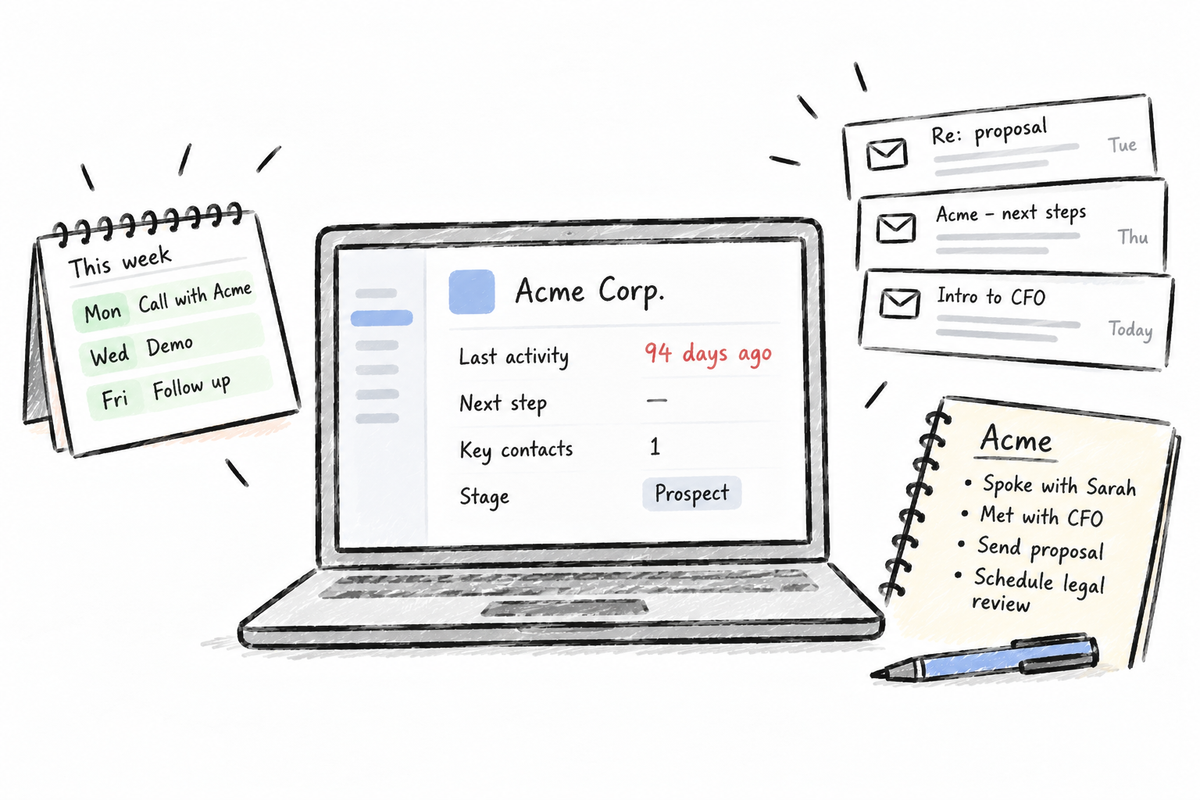
You finish a good conversation with a prospect and go to put your notes in the CRM.
It says the last activity was three months ago.
You know that isn’t true. You’ve spoken to them twice this month. Someone else on the team met their CFO last week. There’s an email thread going back and forth right now.
None of that seems to be here.
So what do you do? You update what you can, put your notes somewhere and move on.
Or maybe you don’t.
This is usually described as a data-quality and discipline problem. And it is certainly that. Salesforce’s own research found that only 35% of sales professionals completely trusted the accuracy of their organization’s data. Its more recent State of Sales research lists duplicate, incomplete and manually incorrect data among the problems sales organizations continue to encounter.
But I think bad customer data is usually evidence of something more interesting.
It tells you how your company behaves.
I’ve worked with Salesforce, HubSpot, Pipedrive and plenty of other systems over the years. They have different strengths, different annoyances and wildly different levels of complexity. There are absolutely circumstances where one is a better tool for a company than another.
But switching tools rarely solves the problem I’m describing because the problem usually didn’t start in the CRM.
The company is what it does
Companies like to talk about who they are.
We’re customer-obsessed. We’re trusted advisers. We care about our customers’ success. We’re responsive, thoughtful, innovative, and easy to do business with.
But all of that language serves to anthropomorphize what is ultimately a legal construct. A company does not have a private self that its customers can see. There is no inner truth underneath its interactions that somehow counts more than the interactions themselves.
The company is what it does.
That’s true of people too. You can believe that you are dependable, but the people around you experience whether you show up. You can think of yourself as thoughtful, but they experience whether you remember what matters to them. You can consider yourself trustworthy, but if you repeatedly fail to keep commitments, your internal assessment of your character isn’t particularly useful to anyone else.
Behavior can change quickly. Reputation takes longer because it belongs to the people who experienced the earlier version of you.
Companies work the same way, only at much greater scale.
A good commercial organization is trying to behave like someone you would actually choose to have a relationship with: competent, interesting, useful and appropriately attentive, with trust underneath all of it.
It knows you. It remembers what you told it. It understands enough about your situation to be useful. It keeps its promises. It offers something when it has something worth offering, and leaves you alone when it doesn’t.
Doing that consistently across fifty salespeople, a range of products, several industries, hundreds of customers and years of employee turnover is an organizational design problem.
The CRM reflects the habits underneath it
This is where I think the usual discussion about CRM hygiene gets the order wrong.
Imagine someone who wants to get healthier. They have a scale, and over time the number on that scale tells them something about the cumulative result of their diet, exercise, sleep and other habits.
If they don’t like the number, they can buy a more expensive scale. They can clean the scale. They can weigh themselves every morning instead of every Friday.
None of those things will cause them to lose weight.
The reading changes when the underlying behavior changes.
Customer data works similarly.
A well-maintained CRM is not the objective any more than a particular number on a scale is the objective. It should be an observable consequence of a commercial organization behaving intentionally.
Did we understand what the customer was trying to accomplish? Did we record something important when we learned it? Did we make a commitment and then keep it? Did we know who mattered in the decision? Did we follow up when we said we would? Did we learn why an opportunity moved forward or stalled?
The CRM matters because it can support those behaviors, preserve their output and allow us to examine them across an organization. But filling in a field after the fact is not the same thing as performing the behavior that field was meant to represent.
The distinction matters because a lot of salespeople don’t experience their CRM primarily as a tool for understanding customers.
They experience it as a tool for understanding salespeople.
How many meetings did you have? How many emails did you send? How active were you this week? Why hasn’t this opportunity moved? Where are you spending your time?
Those aren’t unreasonable things for a company to want to know. But they change the perceived purpose of the system.
There is also a deeper tension that I suspect exists whether people articulate it or not. A great salesperson develops relationships that have real commercial value. Customers know them, trust them and often prefer dealing with them. The salesperson becomes an important part of the relationship.
The more completely the company understands that relationship independently of the salesperson, the less dependent the company is on that salesperson.
That is clearly good for the company. It is also good for the customer. It is not necessarily in the individual salesperson’s narrow economic interest.
So the incentives can start working against each other.
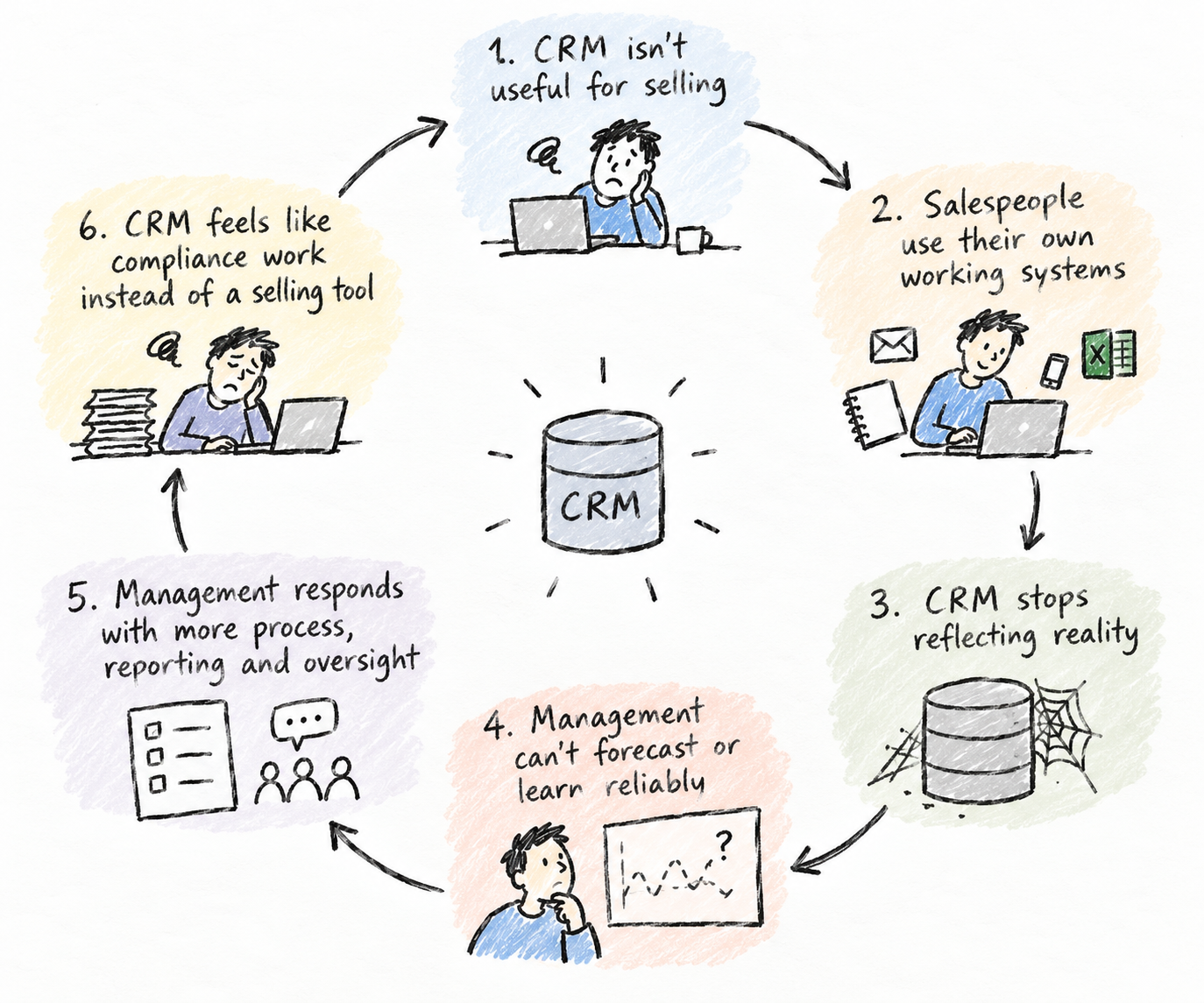
If the CRM is incomplete, it provides little useful insight. Because it provides little useful insight, managers increasingly use the data that does exist to inspect activity. Salespeople experience the system as administrative work and surveillance rather than something that helps them sell. When the CRM stops being useful for selling, salespeople default to their own working systems and update the shared one only as much as they have to.
Management responds with more process, reporting, training, reminders and oversight.
And around we go.
There is some research behind this. A study of 240 salespeople using CRM systems found that perceived usefulness was the strongest influence on acceptance, ahead of factors including ease of use and supervisor encouragement.
If the main benefit I experience from maintaining a system is that someone else gets a better way to inspect me, I’m unlikely to become its most devoted curator.
Why the mess keeps coming back
Companies usually respond to this in one of two ways.
The first is cleanup.
Everybody blocks off Friday. Old opportunities are closed. Accounts are merged. Missing fields get completed. Close dates are updated. By the end of the exercise, Salesforce or HubSpot looks dramatically better.
And then everyone goes back to working exactly as they did before.
Cleaning up after the raccoon does not change the fact that you live with a raccoon.
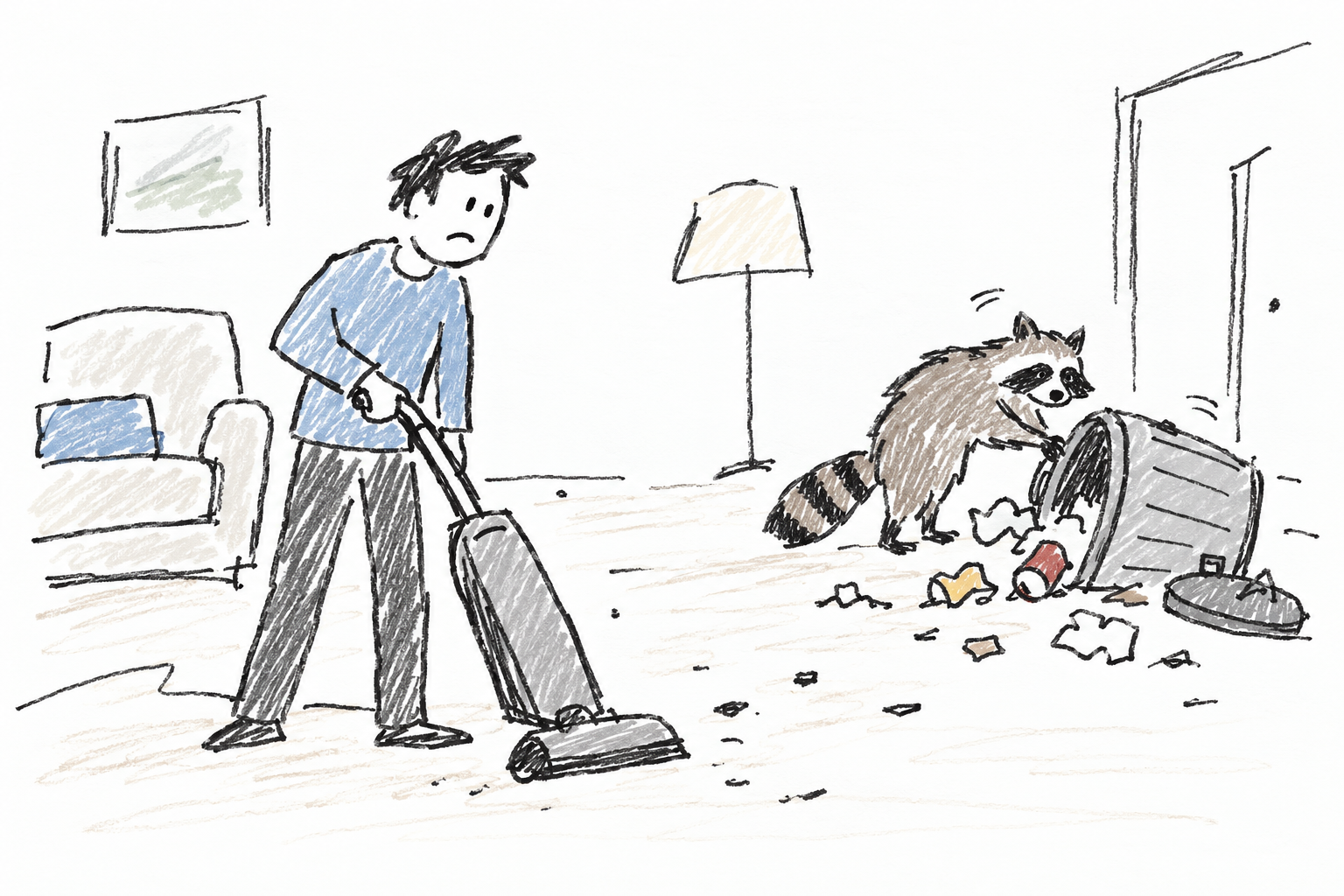
The other response is enforcement.
I’ve seen organizations tell salespeople that they will not receive commission until the deal is properly documented in the CRM.
That works, to a point. The fields get completed.
But it can also produce exactly the wrong causal relationship.
What you wanted was for the salesperson to manage the opportunity in a disciplined way and for the system to reflect that work. Instead, you may have created a salesperson who manages the opportunity however they choose and then reconstructs a compliant record before payday.
The CRM got better but it isn’t clear that the selling did.
This doesn’t mean companies should give up on accountability. A salesperson is responsible for meeting a clearly communicated standard. But if an entire sales team continually fails to meet the standard, leadership probably has a design problem.
Maybe you are hiring people who don’t want to work that way. Maybe you have not explained why the behavior matters. Maybe the tooling makes it unnecessarily difficult. Maybe managers themselves don’t use the information. Maybe successful salespeople are openly allowed to ignore the process because “they hit their number.”
That last one is especially destructive.
If the person at the top of the leaderboard can ignore the process, the company has taught everyone else that the process isn’t really important.
The star salesperson may even be the person whose behavior you most want to understand. But if you exempt them from making that behavior visible, the organization learns almost nothing from their success.
Perhaps their method really is exceptional. Or perhaps they inherited the best territory, the CEO handed them three relationships, market conditions helped, or they are simply unusually charismatic.
If the organization has made no attempt to understand the behavior beneath the outcome, it can only tell stories about why someone succeeded.
That is how a lot of commercial management ends up being done.
The product isn’t competitive. The leads are bad. Marketing isn’t generating enough pipeline. The salespeople aren’t hungry enough.
Some of those explanations may be right, but the trouble is that the company has made itself unusually bad at knowing which ones.
Build the habits, not the hygiene
Before deciding what information everyone must put into the CRM, you need to decide what organizational capability you are actually trying to create.
I think there are at least five useful purposes:
- Performance means understanding whether people are doing the things that contribute to commercial results.
- Learning means understanding what works and spreading that knowledge beyond the person who discovered it.
- Efficiency means making successful behavior easier and less expensive to repeat.
- Reliability means consistently doing what the company says it will do.
- Continuity means making sure the relationship survives the person currently managing it.
Continuity is an especially useful test. Imagine that one of your salespeople unexpectedly stops working tomorrow. Maybe they won the lottery. Maybe something less pleasant happened. Either way, what happens to their customers?
The standard I would aim for is that every relationship continues from exactly where it was. Every commitment the company has made should still be understood and delivered. Everything relevant that the salesperson learned about the customer should remain available. The history of the relationship should survive.
The new salesperson still has to do the human work. They need to build their own credibility and their own relationship. But there should not be a reintroduction between the customer and the company. A customer should not have to explain themselves again to an organization they already know.
Getting there requires more than rules.
The commercial organizations I’ve seen do this well were explicit about what good looked like and designed the environment around it. A new salesperson learned not just the product but the expected way of selling it. They learned the essential parts of the story, then demonstrated that they could tell that story naturally in their own voice. They were taught what the organization expected them to know, what it expected them to do, and why.
The tooling was configured and working before it mattered. Expected behaviors were visible, and people knew how they were performing against them. Because salespeople tend to be competitive, that public visibility could do things another reminder from management never could.
There is nothing particularly pleasant about repeatedly appearing at the bottom of a team measure. It is even less pleasant when you discover that you are there because your email integration has been broken for three weeks and you never bothered to notice. The point isn’t to humiliate people into compliance. It is that habits become easier to sustain when expectations are clear, the behavior is easy to perform, performance is visible and the surrounding culture communicates that the standard actually matters.
The people doing the work also need a voice in how the system evolves. I think of a sports team. The players on the field should absolutely be able to say that a play isn’t working, that they are seeing something different, or that they don’t understand what they are being asked to do. The people closest to the work have information the people designing the system do not.
But at some point, everyone still has to run the same play. “Shut up and follow the process” is a bad learning culture, but “do whatever works for you” isn’t much of a system. The organization needs both discipline and a mechanism for changing the discipline when reality tells you it should.
AI can remove the wrong work
AI may make this easier.
For years, one of the costs of building institutional memory has been asking salespeople to do work that is useful to the company but not particularly valuable to the customer.
Take the notes. Re-enter the notes. Update the opportunity. Add the contact. Record the metric. Note the competitor. Fill in the methodology fields.
Much of that work is increasingly automatable.
If important sales interactions can be captured automatically, a system can recognize when a new person is mentioned, when a commitment is made, when a metric comes up or when a competitor enters the discussion. It can organize that information and make it available to the rest of the company.
Instead of asking salespeople to spend time recording what happened, we can increasingly ask them to spend that time deciding what to do because it happened. What did we learn? What matters? Who needs to be involved? What did the customer not say? What should happen next? Those are much more valuable questions, and they are also much more human ones.
For any consequential purchase, the buyer is putting something of themselves into the decision. They are spending the company’s money, but they are also staking their judgment and credibility on the choice. They want another person on the other side who understands that, is accountable for what has been promised and has some real investment in their success.
If AI takes away the administrative work required to sustain that relationship, that is an enormous improvement. If it takes the human relationship away with it, we have probably automated the wrong thing.
The goal was never a clean database.
The goal was a company that remembers, learns, keeps its promises and gets better at selling because of what it learns. The database is where some of the evidence ends up.