The thing about strategy
Most companies don’t choose obviously bad strategies. The harder problem is building enough commitment, accountability and learning around a reasonable one.

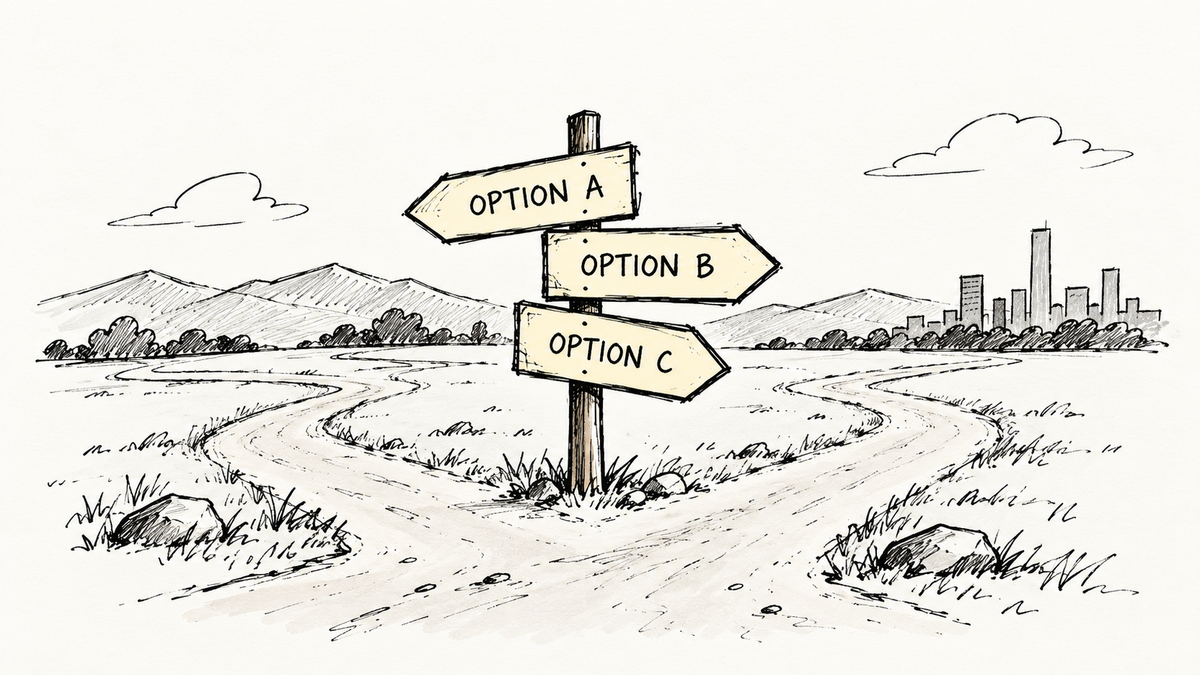
The hard part of strategy isn’t choosing the right path. It’s getting an organization to commit to one.
New Coke? Qwikster? The new Cracker Barrel logo? None of these was obviously a bad idea.
They all sit in the pantheon of stupid decisions made by stupid people and their stupider consultants, but each was a response to a real business problem. Each had a coherent argument behind it. Each was approved by people who understood the company and its circumstances considerably better than most of the people laughing at the decision afterward.
I think the fact that we consistently misjudge strategic decisions after the fact matters because it causes us to misunderstand what has really gone wrong when strategy goes bad. Companies rarely choose between a brilliant idea and an obviously terrible one. They choose among several reasonable paths, each with evidence behind it, real advocates inside the organization, and a reasonable story about why it could work. The harder problem is what happens after they choose.
Strategy isn't really about finding the right path
I spent a good part of my career as a strategy consultant, and I still find the way companies make strategic decisions fascinating. The process looks highly analytical, and it is meant to. Companies build fact bases, study customers and competitors, model markets, interview executives, and construct elaborate arguments about where they should go next. But it is also very human.
People rarely enter a strategy process with no preference about where they would like it to end. It is a little like making a pros-and-cons list when you are deciding between two choices in your personal life. The list looks objective, but if you’re really honest with yourself, you can usually tell which answer you want to win.
Companies work much the same way. Different executives see themselves, their business and the world around them differently. Their preferred strategies flow from those beliefs. The strategy process tests those ideas, builds support around them and eventually produces a choice.
That doesn't make the process illegitimate. Increasingly, I think we simply put too much emphasis on the choice itself, and too much blame on the choice when a business path doesn't end the way we want it to. There usually isn't just one correct path. Strategy's more important job is to make a choice that the organization can actually deliver.
Your third-best idea can beat your best one
Your third-best strategy, fully committed, can be much better than the "optimal" strategy pursued halfway.
By commitment, I don't mean enthusiasm. I don't mean everyone applauding at an offsite at how clever we are, and I don't think everyone in the company needs to agree that leadership chose the best possible path. Commitment is something more concrete and trackable.
A company is committed when the strategy changes how the company operates. It changes what gets funded, what gets measured, what leaders optimize for, and what outcomes people are expected to produce. Most importantly, the company keeps coming back to it. A month from now, or a quarter from now, someone should be asking: What did we expect your part of the organization to contribute to this strategy? Did it happen? If not, why not? What are we going to do about it?
That's not how strategy usually survives contact with planning. Typically, strategy gets translated into a budget, some headcount, and a target. Here is your number. Go do your best. Slowly, the strategy disappears, and people become accountable for doing their jobs rather than testing the assumptions and producing the outcomes the strategy requires from those jobs.
I believe roles inside companies exist to accomplish outcomes, not simply to perform activities, which is less obvious than it sounds. Marketing does not exist to run campaigns. Sales does not exist to make calls. Product does not exist to ship features. Those are things those functions do in pursuit of an outcome the business needs.
You can perform the activity expertly and still fail to produce the outcome. Maybe that's not your fault. The organization may have given a team or individual the wrong resources, structure, or dependencies. The strategy itself may be asking for something the company is not capable of producing. But you still have to start with the fact that the outcome didn't happen. The question isn't whether everyone did their job. It is whether the thing the strategy depended on actually happened.
Strategy needs a common model of reality
For people throughout an organization to make decisions that are consistent with the strategy, they need to understand what the company believes about the world. Two executives can behave completely rationally and still work against each other because they are operating from different assumptions. One believes the greatest threat is a new competitor. Another thinks the competitive threat is overstated and retention is the real problem. One thinks customers are becoming price-sensitive. Another thinks they will pay considerably more for greater capability.
Different beliefs produce different decisions. Without an explicit shared fact base, those disagreements become organizational politics. People negotiate, escalate and exert influence because each is acting on a different understanding of what is true. A strategy has to make those assumptions visible.
Who are the competitors that matter? What do we believe customers want? What will they pay? How efficiently do we think we can acquire them? What do we expect the market to do? People do not have to agree with every assumption, but they should know what assumptions the company is operating from.
Otherwise, people are not just disagreeing about what to do. They are operating in different worlds. Two people disagree about something big, what the world actually looks like, while talking about something small, what one of them needs the other to do. Both may have the interests of the company in mind, but they are talking past one another and creating organizational and interpersonal friction in the process.
Every strategy is a set of assumptions
The assumptions that form the foundation of a strategy matter because every strategy eventually, and usually quickly, runs into something it did not expect.
Before you start, you have a set of beliefs about what needs to happen for the strategy to work. Some of those variables are at least partly within your control: the quality of the product, pricing, customer acquisition, sales effectiveness. Others are much less controllable: the economy, competitor behavior, regulation or changes in customer sentiment. You don't know exactly where any of those variables will land, but you have some expected range in which the strategy should still produce the outcome you are trying to achieve.
Execution gives you evidence against those assumptions. Some things will fall inside the range you expected and some will not. If something you can influence is underperforming, you should focus resources on changing it. If customer acquisition is too expensive, for example, you can change the product, message, channel, sales motion or resource allocation and see whether the number moves.
If something outside your control has changed, the question is different. You need to understand whether that change materially reduces the probability that the strategy can still produce the outcome you wanted. A recession, a new competitor, a regulatory change, or a shift in customer behavior may not be something you can fix. But you should understand what it does to the model you were operating against.
This is what separates commitment from stubbornness. Mike Tyson's line that "everyone has a plan until they get punched in the mouth" is memorable because every strategy gets punched in the mouth. Something will happen that you did not anticipate. In many companies, nobody even notices that an important assumption has broken because nobody is regularly examining the things that need to be true for the strategy to work.
You shouldn't abandon a strategy simply because it encounters resistance. You should reconsider it when the things that need to be true for it to succeed are no longer true, attempts to change the things you can influence are not working, and another path now offers a better probability of producing the outcome. Changing course under those circumstances is not evidence that you lacked commitment. It is evidence that you knew what you were committed to and why.
Strategy should be an operating system, not an event
This is ultimately why I stopped being a strategy consultant and moved into operating roles.
Many companies that hired strategy consultants already had a pretty strong instinct about what they wanted to do. Our job was to build the fact base, pressure-test the argument and package the direction in a way the organization could understand. There isn't anything inherently wrong with that. In fact, if much of the value of strategy comes from creating coherence and commitment around a direction, it can be useful work.
The frustrating part was what happened afterward. When I was doing this work, we literally printed the strategy, put it in a binder and handed it to the client.
Then the binder went on a shelf.
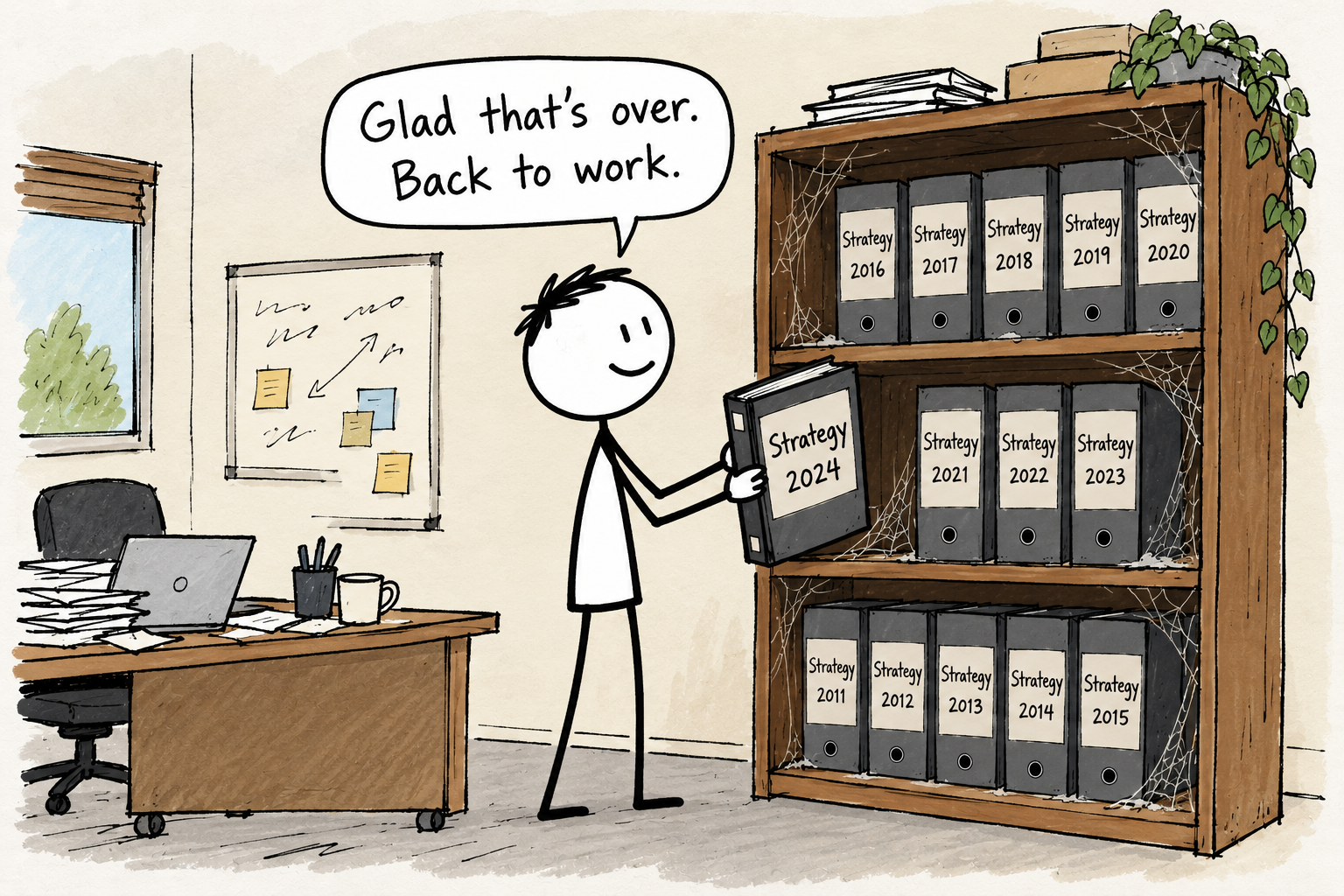
People went back to work. They worked hard, pursued their targets, and tried to improve on the previous year. But the assumptions, choices, and logic that had supposedly defined the company's strategy often had surprisingly little effect on how the company actually operated. That was also the weakness I increasingly saw in an outsider handing a company an "optimal" strategy. If you do not understand what an organization can actually do, how it behaves and which capabilities it has repeatedly demonstrated, you are only partially solving the problem.
I wanted to eliminate that handoff, because the handoff from strategy to execution is where strategy usually disappears. A real strategy needs an operating cadence around it. The organization needs to periodically pick its head up from day-to-day work and ask: What did we expect to happen? What actually happened? Which assumptions still look right? Which don't? What can we influence? What do we need to change? Who is accountable for doing it? Then the organization needs to come back and ask those questions again.
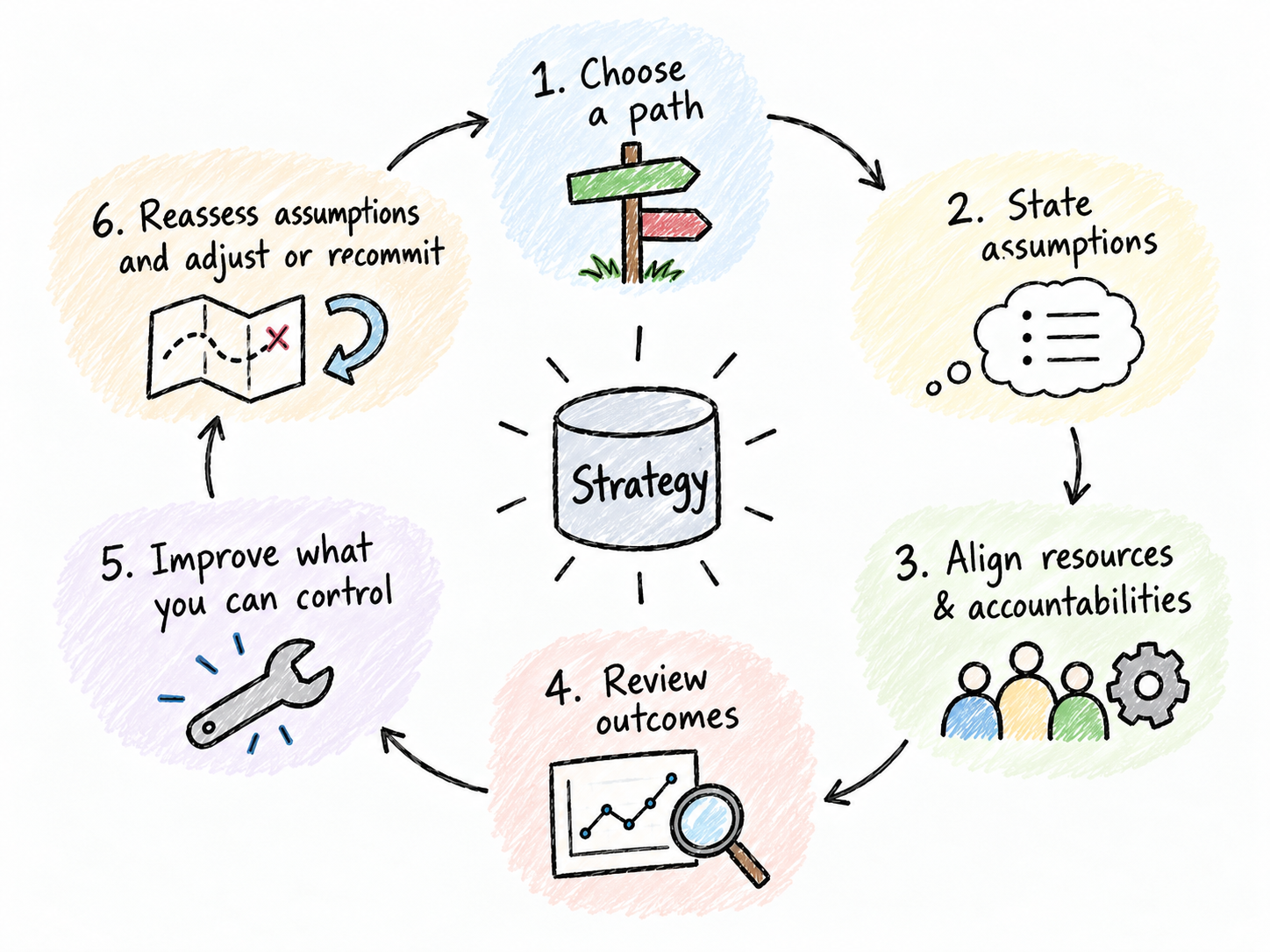
That is not really an annual strategy exercise. It is a management system, and over time that system tells you something important about the company itself. If your strategy repeatedly depends on acquiring customers efficiently and you repeatedly cannot, that is information. It doesn't necessarily mean the people responsible are bad at their jobs. It may be a structural problem, a resource problem or a dependency somewhere else in the organization. But efficient customer acquisition is not currently a strength of the company.
That should affect the next strategic choice you make. The best strategy for an abstract company is not necessarily the best strategy for yours. A strategy that depends on capabilities your organization has repeatedly demonstrated may be superior to one that looks better on paper but requires the company to become something it has never successfully been.
The thing about strategy
The point isn't that execution matters; everyone knows that. And the point isn't that strategy doesn't matter. It matters enormously, just for a different reason than we sometimes imagine.
Strategy is not primarily a search for the one path that guarantees success. There is no such path. It is a way to establish a common understanding of reality, choose a credible direction, organize the company around the outcomes required to make that direction work, and create a system for learning whether the assumptions underneath it remain true.
The choice matters, but what the organization does with the choice matters more. Companies fail at things all the time. The worst strategic outcome is to fail without understanding why, because then you haven't really tested a strategy or learned anything useful about the organization that pursued it.
You've just spent a year doing things.